
CALL NOW & SCHEDULE TODAY
(805) 474-4747
For most people, yes. A cervical adjustment done after a careful exam, by someone who has screened you for the conditions that rule it out, is a low-risk procedure. But low risk is not no risk, and any chiropractor who tells you it is zero has skipped the part that actually protects you. Screening is what makes an adjustment safe. Reassurance by itself is just talk.
The worry you walked in with did not come out of nowhere. Mainstream outlets have run pieces framing neck manipulation as dangerous, including NBC News coverage built around the stories of people who suffered an arterial injury after a visit to a chiropractor. The debate is substantial enough that neck manipulation has its own encyclopedia entry, a good chunk of which is devoted to the risk question rather than the technique. And if you spend ten minutes in a general-interest forum thread, you will find ordinary people narrating their own visits, some delighted and some rattled. If you have read any of that and felt uneasy about booking, that is a reasonable response to the information in front of you.
So here is our position, stated plainly. Serious adverse events associated with cervical manipulation are rare, but they are not zero. That is precisely why the screening conversation matters more than the sales pitch. A chiropractor who answers your question with "totally safe, don't worry about it" has told you nothing you can evaluate. A chiropractor who can describe, step by step, what they examine, what would make them stop, and what they would do instead has told you something you can judge.
The rest of this post is not an argument about whether neck adjustments are good or bad in the abstract. It is a description of what actually happens in our Arroyo Grande office before anyone's hands go near your neck, and what we reach for when the honest answer is that we are not going to twist it at all.
The exam decides the technique. The technique is never decided in advance, and it is never decided from the waiting room. Here is what that workup actually involves.
The intake conversation. We want the story, not just the symptom. When did this start? Was there a specific moment, or did it creep up over months at a desk? Any car accident, fall, sports collision, or whiplash event — even one that seemed minor at the time, even one from years ago? What makes it worse, what makes it better, and what does it do at night? A neck that hurts more at rest than with movement behaves differently from one that locks up when you check your blind spot, and those two necks get handled differently.
Medical and medication history. We ask about stroke or mini-stroke history, heart and vascular conditions, bone density, inflammatory arthritis, connective tissue disorders, recent infections, prior neck surgery or hardware, and blood thinners. People sometimes leave medications off a form because they do not seem related to a stiff neck. They are related. Tell us everything.
Blood pressure. It takes a minute and it occasionally changes the entire plan.
Posture and range of motion. We watch how you hold your head when you are not thinking about it, then measure how far your neck actually moves in each direction and where the movement stops — whether it stops because of pain, because of muscle guarding, or because the joint genuinely will not go further.
Palpation. We feel for where motion is restricted, which is often not the same place that hurts. Tenderness tells you where the body is complaining. Restriction tells you where the problem may be living.
Neurological screening. Reflexes, grip and arm strength, sensation, coordination, and any report of dizziness, visual changes, difficulty swallowing, or unsteadiness. This is the part that separates a mechanical neck problem from something that does not belong in a chiropractic office at all.
Imaging, when it is warranted. After significant trauma, in patients with bone density concerns, when the neurological exam raises a question, or when the history does not match the findings, we request imaging before we do anything. Waiting a few days for a clear picture is not a delay. It is the job.
Some people are not candidates for cervical manipulation. That is not a failure of chiropractic and it is not bad news about you — it is the screening working. These are the histories and findings that make us pause, modify, or decline manual neck adjusting outright:
There is a separate list of symptoms that stop the visit entirely and send you out the door with a referral, same day, rather than onto a table. A sudden, severe headache unlike any you have had before. New dizziness, double vision, slurred speech, facial droop, difficulty swallowing, or numbness on one side. Loss of coordination or a change in gait. Progressive weakness in the arms or hands. Those are not chiropractic findings. They belong to an emergency department or your physician, and we will tell you so directly and help you get there.
Here is the part people miss. Being told you are not a candidate for cervical manipulation is not the same as being told we cannot help you. For the great majority of patients in that category, we are redirecting, not declining. Neck pain, tension headaches, and desk-job stiffness respond to a lot of things that are not a manual adjustment — low-force instrument work, soft tissue care, nerve-focused treatment, laser therapy, and changes to how you sit and sleep. The neck gets care. It just does not get twisted.
Then it does not get twisted. "Please don't adjust my neck" is a complete sentence in this office, and it is not the opening of a negotiation. You do not have to justify it, you do not have to have a diagnosis behind it, and you will not be asked three more times on your way to the table. Plenty of patients arrive having been told their whole lives never to let anyone touch their neck, and they still get better here.
The reason we can say that so easily is that the alternatives are already in the building and we use them every day.
Instrument-assisted and low-force adjusting. Instead of a manual thrust, a handheld adjusting instrument delivers a small, precisely directed impulse to a specific segment. There is no rotation of your head, no sudden movement, and no popping sound. Most patients describe it as a quick tap. It is often our default for older patients, for kids, for anyone with bone density concerns, and for anyone who tenses up the moment a hand touches their neck — which, honestly, is a lot of people.
The Stimpod NMS460. This is a nerve-focused device, and it involves no spinal manipulation whatsoever. It is used to locate and treat irritated peripheral nerves, which matters a great deal when neck pain comes with arm symptoms, burning, tingling, or numbness that a purely mechanical approach never fully resolves. For a patient who wants relief without manipulation, this is frequently where we start. We have written about the Stimpod in more detail elsewhere on the site if you want the mechanics of it.
The TerraQuant super-pulsed laser. No force at all, no contact pressure, nothing moves. The laser is applied over the painful area to support tissue response and reduce pain. It is a comfortable treatment that most people find unremarkable in the moment and useful over a short series of visits. Again, there is a full page on this site that explains how the laser works.
In practice, these are combined. A nervous patient with chronic neck pain and tension headaches might get laser and soft tissue work for the first two visits, instrument adjusting to the mid-back and lower neck once they are comfortable, Stimpod if nerve symptoms are part of the picture, and no manual cervical adjustment ever — or not until they ask for one months later, having watched someone else get one and decided it looks fine. That sequence is entirely normal here. The goal is your neck feeling better, not a particular technique being performed on it.
If your mental image comes from videos, recalibrate. Those clips are selected and edited for drama. A well-performed cervical adjustment is small, quick, and almost boring to watch.
You lie face up with your head supported. The doctor's hands position your head and find a specific contact point, usually with the side of one finger. That setup takes longer than the adjustment itself. The actual movement is shallow and fast — a short, controlled impulse through a small range, not a crank, not a wrench, not a long twist. Contact lasts a few seconds. Many people say the hardest part was anticipating it.
The sound, when there is one, is gas releasing from the fluid inside the joint as pressure changes. It is the same physical event as cracking a knuckle. Nothing is breaking, tearing, or snapping back into place, and the volume of the pop says nothing about how effective the adjustment was. Plenty of good adjustments make no noise at all, which is the norm with instrument work.
Afterward, mild soreness for a day or two is common, similar to the stiffness after a first workout in a while, sometimes with a brief lightheaded or warm feeling as you sit up. That settles. What is not normal: a severe or unusual headache, dizziness that persists or worsens, visual changes, slurred speech, new numbness, or nausea. If any of that happens, call us right away, and if it is severe, go to the emergency department first and call us second. We would far rather hear from you.
And if you tense up on the table, say so. We stop mid-setup. That is allowed, it happens regularly, and nobody is annoyed by it. An adjustment on a guarded, braced neck is not a good adjustment anyway.
There is a style of practice where every patient gets adjusted everywhere, every visit, top to bottom, with as many audible releases as possible. People sometimes read that as thoroughness. It is worth questioning.
Working from how your nervous system is actually responding changes what you do with your hands. Instead of chasing every joint that will make noise, the aim is to find the specific areas where the exam and the neurological findings point, address those, and then re-check to see whether the body responded. If it responded, you leave it alone. If it did not, you reconsider the approach rather than repeating the same thing harder.
That has a direct safety consequence for your neck. Fewer segments adjusted means fewer total cervical manipulations over a course of care. Less force per adjustment means less mechanical demand on tissues we cannot see. Re-checking instead of repeating by habit means the neck gets handled only when there is a reason to handle it, not because it is Tuesday and that is what happens on Tuesdays.
It also changes the pace of care. A specific approach often means the upper neck is left alone entirely while we work on the mid-back, shoulders, and lower cervical segments that are driving the problem — and the symptoms improve anyway. Patients are frequently surprised that the place that hurts is not the place that gets treated.
Thoroughness is what the exam finds, not how many joints make a sound. Those are different things, and the difference matters most at the top of your spine.
Fear of the unknown does a lot of the work in keeping people out of chiropractic offices, so here is the concrete timeline.
You arrive, fill out paperwork or bring forms you completed at home, and sit down with the doctor for a consultation — a conversation, fully clothed, in a chair. You describe what is going on and what you have already tried. This is the moment to say "I am nervous about my neck," and you can say it on the phone when you book instead if you would rather have it handled before you walk in.
Next comes the exam described earlier: posture, range of motion, palpation, neurological screening, blood pressure, and any orthopedic testing your history calls for. If imaging is needed, we tell you then, and we do not adjust your neck while we are waiting on it.
Then there is a report — here is what I found, here is what I think is causing it, here is what I would recommend, here is roughly how long it should take and what it costs. You get to ask questions and you get to disagree. If a cervical adjustment is part of the recommendation, we explain why that technique, describe exactly what it will feel like, and ask for your consent before anything happens. Consent is a separate, explicit step, not something buried in a form you signed at the front desk.
Plenty of patients leave their first visit having had no neck adjustment at all — because the exam pointed elsewhere, because imaging was pending, or simply because they were not ready. That is a normal first visit, not a wasted one. If it helps to hear it from people who are not us, several of the patients in our testimonial videos describe arriving skeptical or outright anxious.
Take this list anywhere, including to our office. A careful practitioner will be glad you asked; the answers tell you more than any review ever will.
If the answers are vague, rushed, or faintly irritated, that is information. If you feel pressure to commit to a long plan before you have had a single treatment, that is also information.
If you live in Arroyo Grande, Grover Beach, or Pismo Beach and you have been putting off doing something about your neck because the treatment scares you more than the pain does, you are not alone and you are not being difficult. Call and tell us you are nervous about your neck. We will start there.




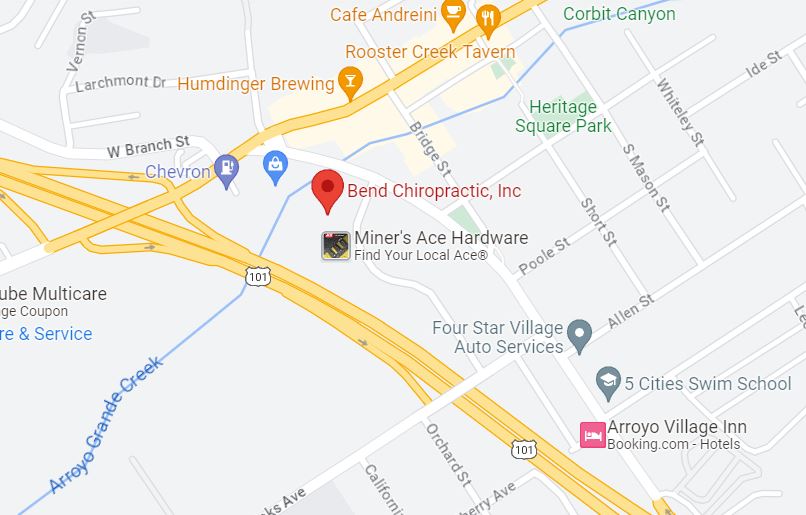 172 Station Way
 SOCIAL


